Wednesday, March 05, 2014

Book 22: The Romance of Tristan

 
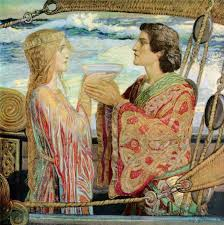
Tristan and Yseut rank up there with Lancelot and Guinevere for notorious/famous adulterous lovers.  In fact, King Arthur even appears in this story, and in some versions, Tristan is an Arthurian knight.  Despite this fame or infamy, I had never actually gone back to the beginning and read the original story, instead relying on references to the couple or reimaginings, or not so good James Franco movies.
 
A literature professor at one point was able to trace back all adaptions and versions of Tristan and Yseut to five different independent sources which appear to themselves trace back to one original lost version.  They don't appear to take from each other but refer to many of the same stories, thus the lost originator idea.  Of these, Beroul's version is commonly believed to be the oldest, and parts of it are missing so that the story here begins with summaries inspired from the other texts before taking up where the remaining text begins, and also ending with summaries as the conclusion of the story is also lost.
 
The story itself is simple, but I had a hard time wrapping my head around some of the specifics - what exactly is Berould trying to accomplish?  Does he want us to see Tristan and Yseut as tragic figures, or is he mocking our ideas of love?  For example, he constantly refers to a group of barons as evil and wicked when all they are doing is telling King Mark that his nephew is sleeping with his wife Yseut.  In other words, they are telling the truth.  There are other things they do in the text that clearly mark them as cowards, but are they evil?  One critic suggests taking Beroul's declarations as truth since conventions of writing were different then, while others suggests viewing this with irony.  When he talks about how virtuous Yseut is while she is in the middle of a tryst with Tristan, we aren't supposed to see them as unfortunate lovers, but instead use the distance Beroul's use of irony provides the reader to make independent judgments.
 
King Mark is clearly incompetent as he is much too trusting of his nephew and wife, constanly giving them the benefit of the doubt.  When he finally is convinced of their guilt and called to action, he once again messes up, delivering judgment without trial.
 
Beroul's writing is dated to mid 12th century Norman France, meaning he would have fallen under the rule of King Henry II.  While generally, the terms courtly love and chivalry refer to traditions developed around this time, Tristan and Yseut's relationship doesn't actually meet those conventions.  Technically neither does that of Lancelot and Guinevere even though the term was first based on them since they actually consummate their relationship.  Strictly speaking, courtly love, a term coined in the 19th century, refers unconsummated relationships where a knight worships a higher lady who looks at him with disdain, thus inspiring him to engage in various acts and quests.  I actually saw one theory that discussed the Celtic origins of this story - though the poem was written in Norman France, and set in Cornwall, there may be a tie to the Picts of present day Scotland, which appears to have been matrilineal, and may have had less strict ideas of marriage.  This argument suggests that the conflict in the text is between the patrilineal barons who want to deprive Tristan of his matrilineal inheritance as Mark's nephew when they convince Mark to marry.
 
Anyway, while the story itself is short and straightforward, it is greatly enhanced by what it may represent culturally and historically, and certainly leaves up lots of things to debate such as the nature of love, and whether Tristan and Yseut are actually good people.  Can you tell that I have to write my final paper on this piece?

Book 21: In Falling Snow

 
In many ways, this novel reminded me of Kate Morton, and that's not necessarily a bad thing.  Both authors are from Australia, and both use the dual narrative set up for their novels, focusing on relationships between women and mothers and daughters.  Technically, Iris is Grace's grandmother but since Rose died during childbirth, she raised her as her own.  The biggest difference is that to me, MacColl's novel didn't have the same page turner quality to it as Morton's novel.  That doesn't mean this wasn't a fairly readable novel, but I didn't have that same need to find out what happened and how it all fit together.  Morton's novels come with a mystery or a twist, and usually the catalyst is someone from a younger generation discovering something odd or mysterious about the past and deciding to dig into it - as a result, it's easy to get invested as a reader and keep reading till everything is revealed.  In comparison, this felt more like Atwood's The Blind Assassin, revolving around an elderly woman's memories as she faces her death.
 
The novel shifts between the novel's present day, 1978, and World War I in France, and the two women, Iris and Grace.  Grace is obstetrician, and is very much still surrounded by sexism in the medical profession as well as other antiquated views.  Her grandfather was a doctor, her mother had been a med student, and Iris made sure Grace had all the right opportunities to follow them.  Though Grace was more drawn to surgery, given the patriarchal views, gynecology made more sense.  Grace's chapters deal with her struggles to balance work, an investigation into a possible mistake, her children, one of whom may have a medical problem, while also facing the fact that her grandmother will not be around much longer.  The chapters focusing on Iris address both the present day, and her time in France during World War I.  Trained as a nurse, Iris went to France to find her 15 year old brother who had lied about his age and enlisted, but she is quickly diverted by Dr. Frances Ivens, a surgeon in charge of a woman run hospital that enlists Iris as her administrator.  The hospital, Royaumont, is what originally inspired the MacColl to write this story, and I enjoyed reading about this.  However, in many ways Iris was rather naive and it is only later in the war, when the hospital starts getting victims that she realizes how awful the war truly is, rather than thinking of it as a noble endeavour.  She tracks down her brother who is part of a postal unit, a comparatively safe assignment, and makes some friends along the way.
 
However, it is obvious that something must have happened, and that Iris is still plagued by regret and guilt.  As it turns out, she has not shared much of her past with Grace at all, so Grace is surprised to discover Iris's role in World War I and Royaumont when Iris receives the reunion invitation.  Additionally, she begins seeing her brother everywhere and confusing people with him.  While it is not quite clear what happened, or why she cut ties with all the people from this period of her life, it soon becomes obvious that Iris did not bring her brother back home.  However, given that it was World War I and the massive amounts of casualties during that war, I can't say I felt like there was too much mystery regarding his fate.
 
I think it was a very good call for MacColl to have Grace also be a doctor so that the reader could see how things at both become easier and stayed the same for women in the medical profession over the years.  While Dr. Ivens had high hopes that their actions would help pave the way, it did not quite work that way as Grace still faced many of the same struggles.  Iris was a very competent character, but I actually found her war time persona a bit too proper and boring, and enjoyed reading about Grace's struggles more than the parts about the war.  I know I made comparisons to both Atwood and Morton but that really had more to do with structure and type of writing than the actual caliber of the writing.  Overall, I liked the book well enough but think it will be ultimately forgettable - a pleasant past time but not more than that.  I could see myself reading more about Royaumont but I already have way too much nonfiction I'm behind on.

Book 20: Beowulf

 
Despite being an English major, I had somehow never read Beowulf.  I knew about Grendel and Grendel's mother but managed to mix their stories with the dragon part of the story.  It was nice to finally catch up with this classic piece, and I'm glad I didn't have to read it in Old English, instead getting this well done translation by Seamus Heaney.  I can't speak as to whether it truly captures the spirit of the poem, but it definitely makes it accessible for a newcomer.
 
Beowulf is a surprisingly straightforward story as it deals with Beowulf, a Geat warrior, and his men coming to assist the Danes with the monster Grendel that has overtaken their land.  There are a few side tales, much like in The Odyssey, and there is also a lot of historical context built in as the story contains genealogy lists, but it moves along very quickly.  Beowulf impresses the Danish king but also shows himself a humble man, refusing to take more reward than he deems fair for ridding the kingdom of its monsters.
 
After the Grendel/Grendel's mother incident, the hero returns home, and the narrative quickly summarizes the next fifty years before Beowulf faces a dragon who sits on the golden treasure of a people long forgotten (gee, I wonder if Tolkien ever read this ... actually, I think his translation may be one of the most famous).  I actually enjoyed the epic poem, and even as it celebrates Beowulf's victories, I feel that there was a certain amount of nostalgia or melancholy.  The story makes reference to all sorts of past days, ancients that have died out, giants of times past - some remembered, some forgotten by time - and shows a great awareness of the future of the Geats without the leadership of Beowulf, predicting the decline of his people.  As a result, this serves just as much as instruction on what makes a warrior and good man as it serves as a remembrance of a leader and his people.

Thursday, February 27, 2014

Book 19: Dust

 
I'm just going to refer to this as a novel even though I know it's a bit more complicated than that.  The concluding volume in Howey's Wool series, Dust starts up where both Wool and Silo left off, focusing on the dual narrative of Silos 1 and 18 with a few appearances from 17.  Juliet's the mayor but coming back has not exactly won her everyone's support.  There is religious unrest, and basically a lot of people are not sure what to expect since Juliet's return has very much stood their beliefs and lives on end.  Despite all this, Juliet is determined to dig to Silo 17 and connect the two spaces.  Donald, meanwhile, is dying and trying to find a way to protect his sister and Silo 18 once he is gone.  Once the siblings are discovered, things get a bit hairy in Silo 1.
 
I think Howey's choices make a lot of sense, even if I don't like all of them.  Instead of embracing Juliet and her revelations, the truth makes people uneasy.  Unfortunately that rings rather true of humanity - some people are angry at new truths, and others hide from them, embracing their old systems even if they are proven wrong.  In fact, Plato talked about this as far back as his Allegory of the Cave.  The person that leaves the cave, sees the light and returns to bring the light to others will be greeted with anger or seen as insane.  As a result, the parts of the narrative I disliked were simply reflections of human nature, and realistic.  Of course, I want the heroes to band together and overcome but unfortunately that's not how things work, and there are still some heartbreaking moments in this novel.
 
I enjoyed this and thought it was a fitting conclusion to the series, though Wool remains the best as far as tension and the characters developed.  There are a few more misunderstandings than I liked between characters here, though once again understandable, especially in relation to communications between Silo 18 and sympathetic supporters in Silo 1.  While I would love to know what happens next, this last book does a good job of wrapping up the big questions without too definitely solving everything.

Monday, February 10, 2014

Book 18: Winter's Tale

 
I bought this book over four years ago based purely on this review.  I didn't actually get around to reading it till last week, when I decided that the movie preview looked intriguing, and that I should read the book before seeing the film.  Having read the book, I definitely still plan on seeing the movie, if only to see how they turned this mess into a coherent, focused story line.
 
That isn't to say the novel is all bad; it's just it kind of meanders off into nothingness by the end.  I also wonder if I may have had higher hopes or more patience for this book than I normally would have due to the movie preview.  For example, after spending the first two hundred pages on one main character, the novel flashes forward into the future and deals with completely different characters and their adventures.  While I wanted to get back to the other character(s), I was more than willing to go with the story and see where it was going - after all, based on the trailer, it was leading to something and was going to come together (see, patience).
 
And other books have done this as well - for example The Passage also moves its narrative forward in time and introduces a whole new cast of characters before finally tying its two story lines together.  As a result, I was willing to be patient.  I also like stories that go off on tangents and move in a leisurely manner if it makes for an enjoyable ride.  Not everything has to have a point - I feel like I've said that exact same thing in another recent review.  However, the character is barely reintroduced after more than three hundred pages of meandering, and even then, he barely seems to be the point of the story anymore.  Basically, stuff happens but it doesn't really end up having much importance or impact.  I will admit the language is descriptive but 700 pages of descriptive language with a bare bones plot is overwhelming, not magical.  I wonder if I would have appreciated this novel more if I was more familiar with New York than just one weekend trip since the previous linked Pajiba review definitely seems to focus on that part of the novel.
 
Now the novel was a bit wordy even from the beginning, and I realize in retrospect that the author was a bit jumpy with the narrative.  However, what works as a narrative device in the beginning of the story becomes very annoying a few hundred pages in.  For example, after introducing a majestic white horse (probably the best character in the whole novel), the story jumps back a bit to explain Peter Lake's background, the man that the horse saved when he was being pursued by the Short Tails.  It turns out Peter Lake used to be a part of that gang, but after making the boss, Pearly Soames, angry, he is their number 1 most wanted man.  This made sense to me.  A bit later, Peter meets Beverly, a young woman dying of tuberculosis, and falls in love with her.  After a chapter where the two of them meet as he is robbing her house, the next chapter picks up at some later point, leaving the reader hanging for half the chapter about the relationship.  As I said, these are things that work for creating tension in the beginning of the novel but I found this same jumpiness and unwillingness to give information to the readers very annoying later in the novel.
 
The novel is definitely not tied to reality and is this weird mix of fantasy/magical realism with other elements, so there is a magical fog that surrounds the city sometimes and disrupts timelines.  After Peter Lake disappears into the fog, the reader knows that he will reappear at some point and isn't actually dead.  It is at this point that the novel introduces the other whimsical characters, who themselves engage in random journeys.  I'm still not sure why we needed the midget that Hardesty met - he literally had nothing to do with the rest of the novel in an already convoluted and packed story.
 
Once Peter finally makes his reappearance in the novel's present, Helprin ignores him for large parts of the narrative, focusing on the rivalry between two newspapers (one of them belonging to Beverly's family), and a bridge.  Given the first two hundred pages (and the movie trailer), I was expecting a love story, but that's really not what this novel was.  I'm still not entirely sure what it was.  The horse was cool, though.  And the first two hundred pages weren't bad.  Even the first four hundred before it became clear that this wasn't really going anywhere.
 
The movie on the other hand has a fair shot of being better than the book since it could tighten the story, cut extraneous pieces and really show the city.  Then again, it is a February release, so who knows.


Book 17: The Second Treatise of Government

 
I read this as part of my masters class on "Social Contract, Class and Wealth."  While it was shorter than some of our other selections so far, I am not entirely made up about my feelings on Locke.  He has become such an important corner stone of what founded our government that it is hard to see things through the appropriate lens.  Instead of being awed and shocked by his view of things, I had more of a "yep, that's how we do things" reaction.  I know I'm being a bit blase.  Actually, he quoted a philosopher named Hooker quite a bit so I'm surprised we don't hear about the guy that influenced Locke more often.
 
Before this we read Hobbes, and though Leviathan is longer and denser, something about Hobbes just appeals to me more.  Hobbes has a pessimistic view of society, and thinks we need someone strong in control.  Locke has a much more positive view of the people and their ability maintain the peace and do the right thing.  However, it is hard to buy Locke's view of human nature when history tends to be on the side of Hobbes.  If we were as good as Locke thinks, wouldn't we already be doing them the way he thinks we should?  Obviously, someone had no issues grabbing power and oppressing people.
 
There were a few other chapters where I couldn't help but look at it from a modern perspective.  He discusses property and how working the land is what gave individuals ownership originally.  I'm okay with these theories and ideas - however, he then basically says that the tribes in America are basically still in this precultivated state and thus don't really own the land.  First of all, it completely ignores the diversity of the Americas and what they were doing, and shows a view biased in favor of Western ideas.  To me, parts of that chapter read as reasons it would be okay to colonize the Americas - "it's not like the Natives are using the land or anything."
 
Still, I am glad I read it since it's such a cornerstone of American believes and views.  And parts of it were certainly enlightening.  In fact, I probably will scan through it again in the next few weeks of class as I finalize my paper topic, and make sure I didn't ignore anything important.  One could definitely see how important the idea of property was to him, and in some ways he had very progressive views, arguing that a son shouldn't be punished for his father's actions.  Basically, if a man rebelled against his ruler unjustly, Locke didn't deem it fair to seize the man's lands and prevent his children from inheriting them.  Only the man himself should be punished.

Friday, February 07, 2014

Book 16: Paris 1919

 
As part of my personal goals to read more nonfiction and to read more about World War I, I decided to finally tackle this book which has been catching my eye for months only to be put aside for shiny new fiction.  MacMillan has a new book out that is about the events leading up to World War I so before I committed to that, I wanted to see how I felt about her writing style in this one.
 
Overall, I really liked it, but some of the information is overwhelming.  Now honestly, I don't think there is much she could have done about this because the goals that the Allies set themselves for this Peace Conference were so large that it would have been hard to include everything and not be overwhelmed.  Almost every country that could sent representatives and some of the delegations numbered in the hundreds.  This conference was a big deal, many smaller, oppressed nations taking hope from the stated goals of the conference, thinking that they may finally get recognition and help.  There was no way this could be anything but dense and information packed.  Having said that, I think she did a very good job of breaking down the topics and presenting them in a digestible manner, even if she sometimes had to reference things that wouldn't be addressed until later chapters such as when discussing the creations of borders for various states.  MacMillan chose to break the book down by areas, focusing on one area at at time, such as the Balkans, Asia, the Middle East, and Eastern Europe.  As a result, there were quite a few times that I had to remind myself that certain discussion were going on simultaneously but having the book organized by time would have been impossible.  Still, the three leaders that were making the decisions (originally Italy was included as part of the Four) were dealing with so many things at the same time it's hard to imagine they had a grasp on anything.
 
Before diving into the details, MacMillan sets the scene, and introduces the main players and drivers.  Woodrow Wilson, David Lloyd George and Georges Clemenceau were the leaders of the US, UK and France respectively, and they would be the major forces in creating the peace treaties.  Wilson had published his Fourteen Points before the conference so that terms like "self determination" were in everyone's mouths.  As the conference progressed, it turned out that these types of ideas and concepts were much harder to put in practice and define than originally thought.  Of course, Wilson's big project for this conference was the establishment of a League of Nations to prevent future wars, and to get rid of secret diplomacy and treaties that he believed led to the Great War to begin with.  MacMillan argues that Europeans were actually very receptive to the idea of the League even if they were not nearly as idealistic about it.
 
One of the things that MacMillan addresses is the accusation or idea that the Treaty of Versailles led to Hitler's rise and World War II.  Personally, I think she does a very good job of arguing that the terms were not nearly as harsh as is commonly believed.  For example, Germany was asked to pay reparations but at this point in time, this was the normal response to warfare.  For example, when France and Germany had been at war in the 19th century, when Germany (or Prussia) emerged victorious, France paid reparations.  As a result, the idea of reparations wasn't nearly as harsh as one would believe.  Additionally, she demonstrates that the numbers could have been much higher, and the terms were actually rather lenient since the peace makers realized they had to keep them low enough that they could get paid and wouldn't topple the economy.  She argues that one of the main problems is that Germany, or at least the common German, didn't realize just how defeated Germany truly was.  Even though the country was facing starvation and citizens were striking on the streets, only the top leaders knew that Germany was done.  However, since the regular German citizen never saw their country occupied, it was easy to believe that they hadn't actually lost the war in the normal sense, and that the Treaty was thus unfair.
 
As far as the rest of the conference is concerned, and the borders it created, there were definitely things that were done wrong.  For example, certain leaders or representatives were particularly eloquent and won concessions for their countries that may not have been in their best interests or the worlds, and resulted in other countries losing territory.  I think Hungary specifically lost a large amount of its land because its borders were handled by three different committees that were all focused on separate countries.  While it certainly seems that some countries were put together piece meal, thus leading to unrest even today, in the case of the Balkans, those countries were actually asking to be put together (though Croatia saw themselves as equals to Serbia in a type of confederacy while Serbia viewed it as adding territory to their country).  For the most part, I'm not sure what better solutions there would have been.  Certainly, the three allies didn't always take their experts into account, but it is hard to imagine any solution that wouldn't have led to problems down the road, especially with countries or disputed areas with very mixed populations.  Other countries were basically left with defenseless borders and quickly swallowed up by others.
 
The main mistakes were definitely made with regard to Asia and the Middle East as MacMillan demonstrates.  Since countries like the US were unwilling to support the racial equality clause that the Japanese demanded, they compromised on other fronts, allowing Japan to maintain control of Chinese territory.  The Middle East especially was just a mess as countries were created arbitrarily and promises made and broken. 
 
In addition to all the intricacies of the treaties, I learned a few other facts I had not been aware of.  For example, I always thought the Austro-Hungarian Empire was called that because the land of Hungary made up such a large part of the territory, but that it was basically controlled by Austria.  As this book shows, by the beginning of World War I, Hungary was basically an equal or partner to Austria.  Additionally, while all the other new countries that emerged after the collapse of the empire were not seen as culpable for the empire's role in the war, Hungary also had to pay reparations and was treated as one of the antagonists along with Germany and Austria.
 
There is so much more in this book as it goes into quite a bit of detail for all the countries (I thought that France was actually rather fair and reasonable in its desired treatment for Germany, and made lots of concessions to maintain their relationships with the US and England) that I haven't even come close to capturing all the topics.  It's definitely a good place to learn about the aftermath of World War I, and how this affects even the present day.